Wednesday, September 27, 2006
Mayo 2005 Internal Medicine Videos


Thursday, September 14, 2006
How to add our Blog to your MyYahoo homepage
How - just click here:
Add to MyYahoo
That is it - if you do this - you will not miss evene a single post from our site...
Wednesday, September 13, 2006
Seven Year Rule and the USMLE
Seven Year Rule and the USMLE
Currently there are 8 States which do not have a 7 year rule concerning the USMLE Examination. What is the 7 year rule? The seven year rule is measured by the total number of years it took to pass the First Step of the USMLE by a physician and the Final Step of the USMLE. If it took more than 7 years between the two then most Boards will not issue a license to the Physician. The Board which have this rule typically will require that the Physician take one of three courses:
1. Retake the Steps of the USMLE which fall out of the 7 year period from the passing of the last Step.
2. Sit and pass the SPEX examination
3. Apply for a waiver of the USMLE 7 year rule. The Physician must provide a valid reason as to why it took longer than 7 years. These typically include family crisis, health issues, Civil Unrest, and Natural Disasters. The route is not guaranteed. The Board can arbitrarily decide not to issue the license.
The States which do not have a 7 year rule for the USMLE are as follows:
| California | Florida | Kansas (10 years) |
| Louisiana | Michigan | New Hampshire |
| New York | Wyoming |
This information is valid as of April 5th, 2006. As with all information posted on this site, it is subject to change. If you have any specific questions you can call the individual Medical Board.
The fastest Medical Boards
# 1 - Indiana Medical Board
The Indiana Medical Board can issue a Temporary License in 2 weeks given that everything falls into place. The Indiana Medical Board has limited verification requirements which allows for an expedited process. The verifications which are required are limited to the NPDB-HIPDB report, Medical School Transcripts, Board Scores, and State License Verifications. Most licenses with Indiana are issued between 1 1/2 to 3 months.
# 2 - Michigan Medical Board
The Michigan Medical Board is the only State with True Reciprocity. If a Physician has held an active License in the USA for at least 10 years, then the only verifications which are required are State License Verifications. Most licenses with Michigan are issued within 1 1/2 months to 3 months. If a Physician hasn't held a license for 10 years then the Physician's Medical School, State Licenses, and Board Scores have to be sent to the Michigan Medical Board.
# 3 - Virginia Medical Board
The Virginia Medical Board is one of the best managed Boards in the United States. Upon the completion of the Physician's file, the licenses are issued within 2 weeks. Although the Board verifies all education and 5 years employment they do not loose verifications in their mail system. If it is mailed to Virginia then it will be placed in your file. This seems trivial but having to request verifications 2 to 8 times (i.e. Arkansas Medical Board & Kentucky Medical Board) can cause significant delays of weeks to months. Our firm is very fast and efficient. This combined with the quality of management at Virginia ranks them as one of the fastest Medical Boards. Most licenses with Virginia are issued after 8 weeks.
Sunday, September 10, 2006
ECGMG - frequently asked questions
- What is the difference between a confirmation report and a status report?
A confirmation report verifies only whether an international medical graduate is ECFMG certified. A status report also verifies ECFMG certification status, but also indicates passing performance on exams, medical school information and the status of the individual's medical education credentials.
- Which examination scores are provided on a status report?
A status report provides information on the examination(s) passed for ECFMG certification. If subsequent examinations have been taken, the requester may have to contact the appropriate registration organization to obtain information on these examinations. Scores for USMLE Step exams are not included in Status Reports. These scores are reported in USMLE transcripts.
- How long does it take to process a request?
Requests are processed within two weeks of receipt of a completed request at ECFMG.
- Can a report be sent by an express mail service?
A response will be sent by an express mail carrier if a prepaid air bill or account number is included with the request form. This service is not available for requests submitted through CVS ON-LINE.
- How can requesters verify receipt and processing of their requests?
ECFMG's Applicant Information Services (AIS) representatives can verify processing of requests. To speak with an AIS representative, call (215) 386-5900.
- Can international medical graduates request a confirmation or status report for themselves?
CVS reports are sent only to third parties. International medical graduates can request a USMLE transcript or ECFMG Exam Chart.
- Are USMLE transcripts sent to state medical boards?
No. ECFMG will provide Status Reports to state medical boards. This report indicates passing performance on examination(s) for ECFMG Certification. State medical boards that require additional USMLE information should contact the Federation of State Medical Boards (FSMB).
- Is there a fee for this service?
Yes. The fee is $25 per report.
- Can CVS fees be paid with a credit card?
Yes. Visa, MasterCard, and Discover credit cards are accepted for payment of the fee of $25 per report. Requesting organizations must complete a Credit Card Payment Form.
- How is incorrect information on a report corrected?
Upon notification of the discrepancy, ECFMG will review the physician's file. In some instances, the physician may be required to submit documents to ECFMG. If information is changed, ECFMG will send a revised report.
- How are requests from "Fifth Pathway" physicians handled?
Fifth Pathway is an American Medical Association program. Fifth Pathway physicians are not certified by ECFMG. As a result, ECFMG does not verify Fifth Pathway status. ECFMG will send a response stating that the physician is not ECFMG certified.
- How are requests regarding graduates of medical schools in Canada and Puerto Rico handled?
Graduates of medical schools in the United States (including Puerto Rico) and Canada are not considered "international medical graduates" and therefore are not required to obtain ECFMG Certification. An ECFMG Identification Number is issued to graduates of Canadian medical schools only for purposes of Exchange Visitor Sponsorship (J-1 visa). ECFMG will send a letter explaining this ECFMG policy in response to these requests.
- What if the requesting organization does not receive the report?
ECFMG will honor requests for duplicate reports at no additional cost up to ninety days after the date that the original report was processed.
Sunday, September 03, 2006
ABIM Internal Medicine boards - 10 Tips
* Study groups: It is crucial that you keep your study group small and stay focused on your ABIM Internal medicine board exam goals. An ideal number would be three or four residents. More than four residents would be counter-productive. Try to have a schedule and read ahead of the planned discussion. By preparing ahead, you will save time, cover more topics and retain more from the discussion. The study group will work best if all participants follow the same board review material. However, different ABIM board review material could also work to your advantage. A good plan is to discuss your ABIM Internal medicine board review study material (Medstudy / Mayo clinic review etc) for the first two hours and then solve multiple choice questions (MKSAP) for the next two hours. Solving multiple-choice questions in groups and discussing each option in detail is vital in developing your thought process and sharpening your clinical decision making skills. You will realize the usefulness of the study group and thank your colleagues when you sit for the actual ABIM Internal medicine boards.
* What to study for ABIM exam: Decide on the ABIM Internal medicine board review material you wish to study from. We have reviewed some commonly used material in this website. The important thing is to choose what works best for you. Choose one ABIM board review textbook and stick to it. It is far more advantageous to revise the same material several times than reading several different materials and getting confused. You must concentrate on solving MKSAP or Medstudy questions at least 50 % of your preparation time.
* Create and devote time to prepare for your ABIM boards. Remember, medical residency is the best time to prepare for the boards. Once your residency is completed, you are thrown out into the real world. If you are starting a fellowship, you will not find much time to study. If you are starting a job as a new physician, your first month will be busy learning the intricate details of medical practice and the paperwork that comes with it. You will most likely, end up designating ten days for study just prior to the exams and as we all know that never works out. So once again, residency is the best time to study. You will not find that kind of quality time after your residency.
* Prepare a schedule to study for ABIM Internal medicine board exams and hang it in a prominent place. You will make several changes to this over time. Plan to revise the ABIM Internal medicine board review material that you have chosen several times (minimum twice). Stay focused throughout the third year of your residency. By middle of the third year, your ABIM Internal medicine board review preparation must be at its peak. If you have not yet formed a study group, now is your last chance.
* Solve questions similar to ABIM exam content: Don’t try to read the ABIM Internal medicine board review material from “cover to cover”. You will not retain much. The best way to prepare is to solve questions, then read the explanation and then look up additional information related to each of the choices (options). This really improves your understanding of the question, familiarizes you with the “teaching principle” and the “testing objective” of that question (which may be repeated in the actual ABIM Internal medicine board exam), and gives you an opportunity to learn about all the other choices and how they differ from the correct answer. Ideally you should be solving MKSAP questions in your second year of residency (PGY 2). If this is not the case, you must definitely begin doing the MKSAP questions by the start of your third year of residency (PGY 3).
* Pictures & Images: Pictures of skin disorders, X-rays and other images given in board questions are generally easy ones to score points. Looking at the image first, before reading the question, usually helps spot the abnormality. Reading the ABIM question’s stem after that will help you put the pieces of the puzzle in place.
* ABIM answering strategies: When reading long multiple choice questions, it may be useful to first read the actual “lead line” of the ABIM Internal medicine board exam question. Once you understand what the question is asking, you can stay focused and look for clues in the long stem of the ABIM exam question. This strategy will also save you time. Several residents have found this strategy useful. As you read through the question, you may also find it useful to underline the key facts and abnormal findings. Once you have gone through the choices, it will be easy to look at the underlined abnormalities and try to “connect the dots”.
* Zebras: Use exam “techniques” to your advantage. Look for target words in ABIM Internal medicine board exam questions. These are referred to as “zebras”. For example in an ABIM exam question, if you see the word “anosmia”, think Kallmann’s syndrome. If you see the phrase “scar on left abdomen”, think splenectomy and look for encapsulated organisms causing sepsis. If the patient is from the Ohio or Mississippi river valleys, think histoplasmosis (CXR calcifications).
* ABIM exam day: Do not study the day before the ABIM Internal medicine boards or in-between the ABIM exam sessions. Discussing the ABIM exam questions with other residents may upset you and adversely affect your performance in the next session. Remember, “What is done, is done”. So don’t cry over spilt milk. Rather, stay focused and conserve your energy for the next ABIM board exam session.
NBOME, COMLEX and USMLE
The NBOME is the National Board of Osteopathic Medical Examiners. It's a nonprofit corporation dedicated to serving the public and state licensing agencies by administering examinations testing the medical knowledge of osteopathic medical students and interns. The NBOME was established in July 1934. Its website is at http://www.nbome.org
What is the COMLEX?
In order to more accurately measure the knowledge required by today's physicians, the NBOME initiated the three-level Comprehensive Osteopathic Medical Licensing Examination (COMLEX-USA) to replace the former three-part NBOME examination series. The COMLEX is a three part exam. Each exam is administered over a two day period, and employs an osteopathic primary care approach to patient care fully integrated throughout the examination.
What is the USMLE?
The USMLE is the United States Medical Licensing Exam -- it is taken by allopathic medical students and interns. It is administered by a Committee Consisting of representatives of the Educational Commission for Foreign Medical Graduates (ECFMGSM), the Federation of State Medical Boards (FSMB), the National Board of Medical Examiners (NBME), and the public. The Composite Committee establishes policies and procedures for the USMLE program. The USMLE website is at http://www.usmle.org.
When do medical students and interns take the COMLEX?
The first COMLEX is usually taken at the completion of the second-year of medical school. The next COMLEX is taken during the fourth year of medical school. The final exam is taken during the internship (first residency year).
Why do I need to take the COMLEX?
All states require you to have passed a licensing exam before they will issue you a license to practice. Most osteopathic medical schools require COMLEX as part of the process towards graduation. It is also used by residency programs to make selections of who they will interview and accept for their program. Usually this decision is made only with the scores from the first COMLEX.
Monday, August 21, 2006
Delay in STEP 2 CK SCORE REPORTS
Normal score reporting for Step 2 Clinical Knowledge (CK) usually occurs in 3-4 weeks. However, because of necessary modifications to the test item pool, it will be necessary to delay the reporting of scores of some examinees for an additional 3-4 weeks beyond the normal turnaround period. The target date for reporting Step 2 CK scores for most examinees testing from August 3 through the middle of August will be Wednesday, September 13, 2006.
2006 Match Performance - Number of IMGs Matching Increases
For the fourth consecutive year, the number of first year (PGY-1) residency positions offered through the Match increased. A total of 21,659 first year positions were offered in the 2006 Match, held earlier this month. This represents an increase of 205 positions compared to last year and an increase of 1,057 positions since 2002.
The number of IMGs who matched to first year positions increased by 152, compared to 2005. Of the 8,877 IMGs who participated in the 2006 Match, 4,382* (49.4%) matched. In the 2005 Match, 4,230 (55.3%) IMG participants were matched to first year positions.
There was an increase in the number of matches for both U.S. citizen IMGs and IMGs who are citizens of other countries.
Of the 6,442 IMG participants who were not U.S. citizens, 3,151 (48.9%) obtained first year positions. The number of non-U.S. citizen IMGs who obtained positions in 2006 increased by 64 compared to last year. This is the fifth consecutive year that there has been an increase in the number of non-U.S. citizen IMGs matching to first year positions.
Of the 2,435 U.S. citizen IMG participants, 1,231 (50.6%) were matched to first year positions, an increase of 88 over last year. This is the third consecutive year that there has been an increase in the number of U.S. citizen IMGs matching to first year positions.
There were 51 Fifth Pathway participants in the 2006 Match. Of these 51 participants, 22 (43.1%) were matched to first year positions.
*Note: The total number of IMGs who will fill PGY-1 positions for the 2006-2007 academic year will be higher than this number, since a significant number of IMGs obtain PGY-1 positions outside of the Match.
Source: http://www.ecfmg.org/announce.htm#matchperformance
Friday, August 18, 2006
resources for Step 1 - Highly Recommended
Kaplan Video Lectures - very popular among medical students.
NBME online practice test-there are 150 free questions on the internet plus I think you can buy more. Will make you feel much better about yourself compared to Q Bank. Suggest you take it as 3, 50 question tests towards end of studying. Comparable to actual boards.
Kaplan webprep (online lectures) and lecture material
University of Utah’s “Webpath”-some students thought it was helpful
Books - highly recommended for USMLE Step 1
Histology: Section in First Aid is good enough-High Yield has some good pictures you might want to check out
Neuroscience: High Yield Neuroanatomy
Physiology: BRS Physiology-MUST HAVE
Biochemistry: High Yield Biochemistry
Human Behavior: High Yield Human Behavior
Pathology: BRS Pathology-MUST HAVE
Microbiology/Immunology: High Yield is great-good tips for memorization, LANGE for Immunology is probably your best bet, High Yield is OK for immunology
EBM: High Yield Human Behavior, Section from First Aid is adequate-you will just have finished EBM with Dr. Davidson-so don’t stress this topic
Pharmacology: High Yield Pharm and section in First Aid will be enough-test out on pharm shelf and and adjust accordingly
Must have books for Step 1
If reading only one book, this would be the one.
Good overall subject review with advice on all aspects of taking the boards.
Room to fill in extra notes (may want to get your own to scribble in)- This book can only take you so far. I encourage you to take notes from other sources and transfer into this book. Therefore, your last few days of studying you will have all the highest yield info in one book.
Good review of most available books and resources (gives all the other review books a “grade”)
Which USMLE Step One materials/courses did you use?
% of Class Study material/course Score
97.6% Online Qbank 3.74
34.4% Northwestern 1.64
31.1% What You Need To Know 3.34
12.9% Kaplan Live 3.11
0.5% Falcon Review 2.00
94.7% First Aid 3.69
76.1% BRS 3.21
5.7% Other 3.33
Understanding Funding opportunities: Student Jobs, Scholarships & Assistantships
How do we fund our education while studying at an American University ?
There are three standard sources for Masters and PhD students, which are often clubbed together in a single concept "Financial Aid"
1. Student Jobs: These are the various student jobs that one can on-campus such as Dining services, Library, Book stores, Computer Labs, etc. These jobs typically pay about 6 to 10 dollars an hour and have NO fee waivers.
2. Scholarships : This refers to either partial or complete fee/tuition waivers (i.e. discounts) with or without a monthly or semester scholarship money. These are highly variable and are granted either at the department level or the University level. There are official deadlines for these, so look them on the websites!
3. Assistantships: These are the most sought after funding opportunities because they make life much easier and look good on the resume too.
Assistantships are of two types : Research Assistantships and Teaching Assistantships. Now, each of these assistantships can either be half-time (20 hours a week) or Quarter-time(10 hours a week) & typically pay about 11.5 to 15 $ per hour. Besides a monthly stipend, assistantships normally include a complete tuition waiver (i.e. complete academic fees discount) AND in most universities now include a free health insurance
A teaching assistant teaches some parts of a course (especially assisgnment discussions and paper gradings) to the undergraduate students. So people, if the department you are applying to, does not have any undergraduate courses, there wont be a teaching assistantship offered !
In many universities, assistantships are often offered automatically to some admitted PhD students. In other cases, they may be reserved only for the students of that particular department. In such cases, some students have known to opt for a dual degree to be eligible for these. For example, I knew a student who came to my university for a Masters in Electrical Engineering and signed up for a dual degree in BioEngineering to get a Assistantship from the BioEngineering Department ! [which obviously also means an extra year - but two Masters :-)]
Top Residency Programs
The Top THREE Residency Programs in Internal Medicine (2006 US News Report)
1. Johns Hopkins University
2. Harvard Medical School
3. University Of California - San Francisco
The Top THREE Residency Programs in Family Medicine (2006 US News Report)
1. University of Washington : Website
2. University of North Carolina-Chapell Hill
3. University of Missouri-Columbia, University of Wisconsin-Madison
The Top THREE Residency Programs in Pediatrics (2006 US News Report)
1. Harvard University
2. University of Pennsylvania
3 . Johns Hopkins University
Saturday, August 12, 2006
Looking for free USMLE Step 2 CS cases
Try here:
http://usmlestep.com/usmlecsa-step2cs.htm
Pass Program Videos - Dr. Francis empowers you for USMLE
The breakdown of those materials are as follows:
DVD1: Endocrine, Gastrointestinal, Hematology, and Immunology 1 & 2, Goljan Audio and Notes
DVD2: Metabolic physiology, Pulmonary functions, Renal functions and Muscle physiology, Biochemistry 1 & 2,
DVD3: Microbiology, Cardiovascular, Cell & Membrane Physiology, Neurology and Vitamins, 300+ pages notes.
Read more about Pass Program Videos from Dr. Francis here
Saturday, July 22, 2006
42 day Study Schedule for USMLE Step 1
http://4usmle.net/forum/index.php?showtopic=51
Many USMLE takers consider this as one of the MUST HAVE for Step 1 preparation.
Sunday, July 16, 2006
ECFMG (Educational Commission for Foreign Medical Graduates) Information
The ECFMG is the organization charged with ensuring that physicians who have graduated from foriegn medical schools are qualified to pursue a medical license in the United States. Being certified by the ECFMG is a pre-requisite to applying for the USMLE Step 3 exam, and a pre-requisite for entering an ACGME-accredited residency program. Visit ECFMG.org for details and official requirements.
Eligible Medical Schools
Only students who attended medical schools listed in the International Medical Education Directory (AKA IMED) are eligible to apply for ECFMG certification. The standards are even more strict than simply being listed: a student's year of graduation must also be listed in the IMED database. That is, if you graduated from a medical in a year that your school was not accredited by IMED, you cannot apply to the ECFMG.
Examination Requirements to Apply for ECFMG
In addition to the medical education portion of the requirements, applicants must pass USMLE Step 1, USMLE Step 2 (clinical knowledge and clinical skills). As long as you are eligible to take these exams, you may take them in any order. For detailed information on requirements visit the ECFMG official site.
Residencies can be hard to find for international medical graduates. A variety of resources are available to help with the match and scramble, we recommend the IMG Residency Guide.
Saturday, July 15, 2006
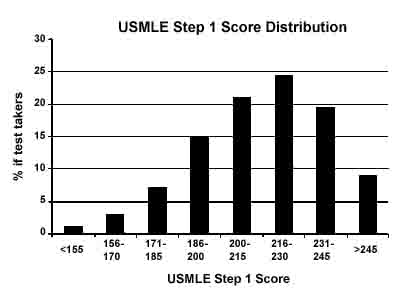
USMLE score distribution
Most applicants have a general impression of how competitive their USMLE scores are, but it's difficult to get data to support their impressions. We've compiled some data on how competitive USMLE scores are for different situations. Since residency programs are notoriously tight-lipped (and appropriately so) about the USMLE scores of their residents, we can't guaranty any of the conclusions - but we do think they are in the right range. Let us know what you think after you visit this USMLE scores page.
- top internal medicine programs are looking for step 1 scores of 230 or better.
- the average usmle step 1 score for applicants who matched in ophthalmology had a score of 224 (those who didn't match had an average score of 206).
- Passing score (as of 1/16/04) is 182 according the NBME official USMLE site.
- The average score is about 214 (estimate from the score distribution).
Saturday, July 08, 2006
Medstudy Videos sale
1 Version is 20 DVDs - in raw MPEG format -they can be played on any DVD player.
2 Version is 4 DVDs - in DIVX format (MP4 container) - they can be played on computer with the help of software DIVX player. You can read more about DIVX format here.
If you look for a place to buy Medstudy Videos - try looking here
Change in Minimum Passing Requirements for Step 2 Clinical Skills
| Change in Minimum Passing Requirements for Step 2 Clinical Skills | |||
| |||
Read more about this at:
http://www.usmle.org/step2/Step2CS/Step2Indexes/Step2CSIndex.htm#change
What are the most popular Step 2 CS Physical Exam Videos
- University of Washington Physical Exam movies
- University of Virginia Physical Exam movies
- Connecticut Physical Exam movies
http://usmlestep.com/usmlecsa-step2cs.htm
Google keywords leading to this USMLESTEPS blog
It is really funny to check my stats and track down which google keywords land people on this site...
Perhaps you also used one of them to get here.... Some of them are very very funny!
goljan
goljan audio
kaplan notes for step
kaplan step
usmle 4 prep goljan 100 page
dr john baron pathologist for kaplan
usmle videos dvds
kaplan video vs webprep
kaplan step 3 dvds
kaplan usmle
free goljan audio
usmle step cs video
exam master forum
usmle kaplan dvd
goljan step
kaplan qbank
goljan audio step 1
webprep pathology
goljan step 2 hy notes
kaplan medical step 1 pathology 2004 edition
harrison s 16th pdb free download
dr edward goljan pathology
kaplan review medical students board prep
www usmle.com
usmle pass program outline lectures
usmle kaplan location
usmle kaplan us location
kaplan step 3 dvd
kaplan step 3 dvd lectures notes
How imp is CS getting a residency
USMLE CSA HELP
physical exam csa
step 2-CS USMLE test sites and scheduling
how to approach cases of counselling in step cs
instant message abbreviation BP
mnemonics for taking history and physical examination
headache usmle cs
online USMLE quizzes
Cardiac Examination Videos
CS Trick Spray
mnemonic for medical history taking
step 2 csa free scenario
CVS Exam auscultation chart
CSA test center Atlanta
address of Houston Test center for CSA
edxam cost USMLE
Step 2 CS Cases
Friday, July 07, 2006
Looking for Canada Medical Exam Study Materials (MCCEE or MCCQE)?
To be eligible for MCCQE Part 1, IMGs must pass the Medical Council of Canada Evaluating Examination (MCCEE). The MCCEE is held in various locations throughout Canada and the world, and is open to all IMGs holding an acceptable medical degree.
Passing the MCCEE gives access to MCCQE Part 1. For access to Part 2, both a pass standing on Part 1 and previous completion of twelve months of postgraduate training are required. This training may be taken anywhere in the world.
There is a lot of overlap between USMLE and MCCEE/MCCQE - try http://www.usmlestep.com for more information about USMLE materials.


 Posts
Posts


